Monday, 4 June 2018

Background of Faith

The Word of God in the Old Testament or Hebrew Writings as well as in the New Testament or Greek Messianic Writings speaks about people who had a faith or certain believe in a Higher Power, the Most High Maker Elohim Hashem Jehovah.

We can see or read that faith has something to do with having a belief in things which we are not sure of and of things we can not see. When there is faith present than this means that person is being sure of the things he or she hopes for and knowing that something is real even if we do not see it. For those people having faith "Faith" is the reason they remember great people who lived in the past, like Enoch, Noah, Abraham who were all great people who died in faith and whose stories are told in the set apart or Holy Scriptures.

Those great people whose stories can be an example for us did things because they believed in them and believed in the One for Whom they did it. The Nazarene man Jeshua (Jesus Christ) also had such a strong believe in the One Whom sent him, that he was prepared to put his own will aside to do the Will of his heavenly Father, the Only One True God of Israel. He totally trusted his heavenly Father and asked us also to trust Him Who had sent him.

With our belief in Jesus we should trust in what Jesus told us and in what his heavenly Father has to offer us. Looking at figures as Sarah, King David, Isaiah, Jeremiah we can find reason enough to believe in their writings and find Zechariah and other prophets telling us about what we might expect in the near future, the Messiah bringing us a world of peace.

Looking at Scriptures we may find assurance that all the prophesies told in it which did not come true shall also come true as the other accomplished. We can live by hope that it shall not be not for nothing to live a sanctified life and to have put our hope on the yet unseen with the absolute conviction that there are realities we have never seen but may be sure of that they shall come true.

It was by faith that our forebears were approved. Through faith we understand that the universe was created by the Word of God; everything we now see was fashioned from that which is invisible.

Faith begins as hope and indeed is unseen; so many doubt that it is real. The bible gives all the answers we need to know and provides the proof that faith is a reality that can be trusted.

+

Please read also Hebrews 11 and following articles

  1. Devotees and spotters
  2. Can you question the existence of God
  3. Are there certain books essential to come to faith 
  4. Looking to the East and the West for Truth
  5. Israeli leaders delight in Europe’s cruelty toward refugees
  6. Islam says it admires faith based on logic, what about the others
  7. Honest-hearted people are losing faith in humanity and humanity losing faith in God
  8. No insurmountable obstacles to come to know God
  9. Challenging claim 2 Inspired by God 1 Simple words
  10. Challenging claim 4 Inspired by God 3 Self-consistent Word of God
  11. Miracles of revelation and of providence 1 Golden Thread and Revelation
  12. Disobedient man and God’s promises
  13. God’s forgotten Word 5 Lost Lawbook 4 The ‘Catholic’ church
  14. Cognizance at the doorstep or at the internet socket
  15. Daily Spiritual Food To prepare ourselves for the Kingdom of God
  16. Knowing The Truth and Loving The Truth
  17. Faith
  18. God Will Lead 
  19. The Right One to follow and to worship
  20. Omniscient God opposite a not knowing Jesus
  21. Meaning of Sacrifice
  22. For The Love of Stuff
  23. Matthew 6:1-34 – The Nazarene’s Commentary on Leviticus 19:18 Continued 2 Prayer and neighbour love
  24. Matthew 8:5-13 – The Nazarene’s Commentary: Servant of Army Officer Healed
  25. Matthew 9:18-26 – What others say about Jesus knowing how to care for people
  26. Redemption #7 Christ alive in the faithful
  27. God has not destined us for wrath
  28. Hope by faith and free gift
  29. Memorizing wonderfully 3 Practical Tips for Memorizing Scripture
  30. Leaving the Old World to find better pastures
  31. Like grasshoppers
  32. With all your heart
  33. Establish your hearts blameless in holiness
  34. When having found faith through the study of the Bible we do need to do works of faith
  35. Do those who want to follow Christ to be Jews
  36. The works we have to do according to James

Sunday, 3 June 2018

Negative views of immigrants, Muslims and Jews

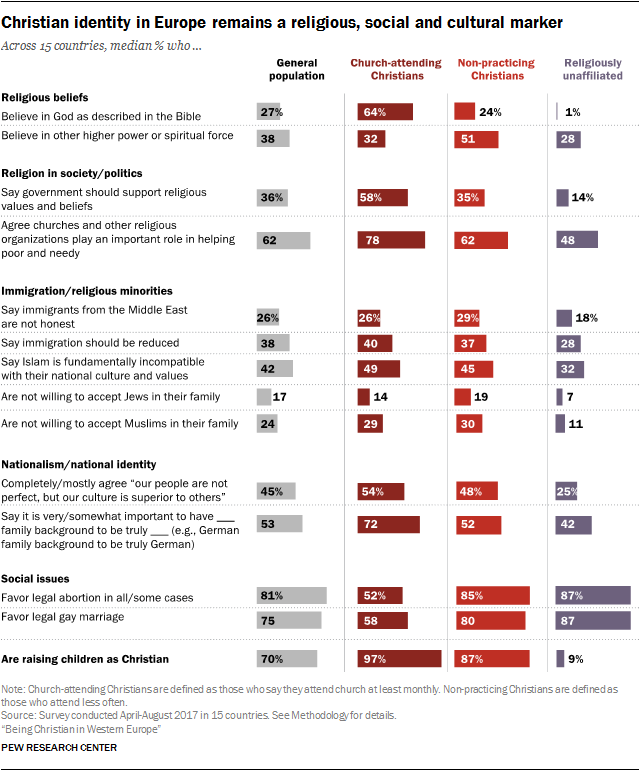
Both non-practicing and churchgoing Christians are more likely than the unaffiliated to hold negative views of immigrants, Muslims and Jews

The Pew Center survey, which was conducted following a surge of immigration to Europe from Muslim-majority countries, asked many questions about national identity, religious pluralism and immigration.

Most Western Europeans say they are willing to accept Muslims and Jews in their neighbourhoods and in their families, and most reject negative statements about these groups. And, on balance, more respondents say immigrants are honest and hardworking than say the opposite.
But a clear pattern emerges: Both church-attending and non-practicing Christians are more likely than religiously unaffiliated adults in Western Europe to voice anti-immigrant and anti-minority views.
For example, in the UK, 45% of church-attending Christians say Islam is fundamentally incompatible with British values and culture, as do roughly the same share of non-practicing Christians (47%). But among religiously unaffiliated adults, fewer (30%) say Islam is fundamentally incompatible with their country’s values. There is a similar pattern across the region on whether there should be restrictions on Muslim women’s dress, with Christians more likely than “nones” to say Muslim women should not be allowed to wear any religious clothing.

Views on relationship between government and religion

Views on relationship between government and religion

Results of the Pew research Center survey:

Generally speaking, Western Europeans do not look favourably on entanglements between their governments and religion. Indeed, the predominant view in all 15 countries surveyed is that religion should be kept separate from government policies (median of 60%), as opposed to the position that government policies should support religious values and beliefs in their country (36%).

Non-practicing Christians tend to say religion should be kept out of government policy. Still, substantial minorities (median of 35%) of non-practicing Christians think the government should support religious values and beliefs in their country – and they are much more likely than religiously unaffiliated adults to take this position. For example, in the United Kingdom, 40% of non-practicing Christians say the government should support religious values and beliefs, compared with 18% of “nones.”
In every country surveyed, church-attending Christians are much more likely than non-practicing Christians to favour government support for religious values. In Austria, for example, a majority (64%) of churchgoing Christians take this position, compared with 38% of non-practicing Christians.


The Pew survey also gauged views on religious institutions, asking whether respondents agree with three positive statements about churches and other religious organizations – that they “protect and strengthen morality in society,” “bring people together and strengthen community bonds,” and “play an important role in helping the poor and needy.”
Three similar questions asked whether they agree with negative assessments of religious institutions – that churches and other religious organizations “are too involved with politics,” “focus too much on rules,” and “are too concerned with money and power.”
Once again, there are marked differences of opinion on these questions among Western Europeans across categories of religious identity and practice. Throughout the region, non-practicing Christians are more likely than religiously unaffiliated adults to voice positive opinions of religious institutions. For example, in Germany, a majority of non-practicing Christians (62%) agree that churches and other religious organizations play an important role in helping the poor and needy, compared with fewer than half (41%) of “nones.”
Church-attending Christians hold especially positive opinions about the role of religious organizations in society. For example, nearly three-in-four churchgoing Christians in Belgium (73%), Germany (73%) and Italy (74%) agree that churches and other religious institutions play an important role in helping the poor and needy. (For more analysis of results on these questions, see Chapter 6.)

Non-practicing Christians widely believing in a god or higher power


Non-practicing Christians widely believe in God or another higher power

Of those who call themselves Christian the majority believe in the Trinity and not as such  as Pew count them as believers in God as described in the Bible. In the 27% who believe in God, the majority believe in a concept they were brought up with, some Catholics even not knowing that their church worships a Trinity, or do not know what it entails. Non-trinitarian Christians though still may be counted as the minority


Most non-practicing Christians in Europe believe in God. But their concept of God differs considerably from the way that churchgoing Christians tend to conceive of God. While most church-attending Christians say they believe in God “as described in the Bible,” non-practicing Christians are more apt to say that they do not believe in the biblical depiction of God, but that they believe in some other higher power or spiritual force in the universe.
For instance, in Catholic-majority Spain, only about one-in-five non-practicing Christians (21%) believe in God “as described in the Bible,” while six-in-ten say they believe in some other higher power or spiritual force.
Non-practicing Christians and “nones” also diverge sharply on this question; most unaffiliated people in Western Europe do not believe in God or a higher power or spiritual force of any kind. (See below for more details on belief in God among religiously unaffiliated adults.)
Similar patterns – in which Christians tend to hold spiritual beliefs while “nones” do not – prevail on a variety of other beliefs, such as the possibility of life after death and the notion that humans have souls apart from their physical bodies. Majorities of non-practicing Christians and church-attending Christians believe in these ideas. Most religiously unaffiliated adults, on the other hand, reject belief in an afterlife, and many do not believe they have a soul.
Indeed, many religiously unaffiliated adults eschew spirituality and religion entirely. Majorities agree with the statements, “There are no spiritual forces in the universe, only the laws of nature” and “Science makes religion unnecessary in my life.” These positions are held by smaller shares of church-attending Christians and non-practicing Christians, though in most countries roughly a quarter or more of non-practicing Christians say science makes religion unnecessary to them. (For a detailed statistical analysis combining multiple questions into scales of religious commitment and spirituality, see Chapters 3 and 5.)

Being Christian in Western Europe at the beginning of the 21st century #2

The figures you find in #1 raise some obvious questions:
  •  What is the meaning of Christian identity in Western Europe today?
  •  And how different are non-practicing Christians from religiously unaffiliated Europeans – many of whom also come from Christian backgrounds?
The Pew Research Center study – which involved more than 24,000 telephone  interviews with randomly selected adults, including nearly 12,000 non-practicing Christians – finds that Christian identity remains a meaningful marker in Western Europe, even among those who seldom go to church. It is not just a “nominal” identity devoid of practical importance. On the contrary, the religious, political and cultural views of non-practicing Christians often differ from those of church-attending Christians and religiously unaffiliated adults. For example:
  • Although many non-practicing Christians say they do not believe in God “as described in the Bible,” they do tend to believe in some other higher power or spiritual force. By contrast, most church-attending Christians say they believe in the biblical depiction of God, though of most of them we do know they believe in the human doctrinal god, namely the trinity. And a clear majority of religiously unaffiliated adults do not believe in any type of higher power or spiritual force in the universe.
  • Non-practicing Christians tend to express more positive than negative views toward churches and religious organizations, saying they serve society by helping the poor and bringing communities together. Their attitudes toward religious institutions are not quite as favourable as those of church-attending Christians, but they are more likely than religiously unaffiliated Europeans to say churches and other religious organizations contribute positively to society.
  • Christian identity in Western Europe is associated with higher levels of negative sentiment toward immigrants and religious minorities. On balance, self-identified Christians – whether they attend church or not – are more likely than religiously unaffiliated people to express negative views of immigrants, as well as of Muslims and Jews.
  • Non-practicing Christians are less likely than church-attending Christians to express nationalist views. Still, they are more likely than “nones” to say that their culture is superior to others and that it is necessary to have the country’s ancestry to share the national identity (e.g., one must have Spanish family background to be truly Spanish).
  • The vast majority of non-practicing Christians, like the vast majority of the unaffiliated in Western Europe, favour legal abortion and same-sex marriage. Church-attending Christians are more conservative on these issues, though even among churchgoing Christians, there is substantial support – and in several countries, majority support – for legal abortion and same-sex marriage.
  • Nearly all churchgoing Christians who are parents or guardians of minor children (those under 18) say they are raising those children in the Christian faith. Among non-practicing Christians, somewhat fewer – though still the overwhelming majority – say they are bringing up their children as Christians. By contrast, religiously unaffiliated parents generally are raising their children with no religion.


Religious identity and practice are not the only factors behind Europeans’ beliefs and opinions on these issues. For instance, highly educated Europeans are generally more accepting of immigrants and religious minorities, and religiously unaffiliated adults tend to have more years of schooling than non-practicing Christians. But even after statistical techniques are used to control for differences in education, age, gender and political ideology, the survey shows that churchgoing Christians, non-practicing Christians and unaffiliated Europeans express different religious, cultural and social attitudes. (See below in this overview and Chapter 1.)

These are among the key findings of a new Pew Research Center survey of 24,599 randomly selected adults across 15 countries in Western Europe. Interviews were conducted on mobile and landline telephones from April to August, 2017, in 12 languages. The survey examines not just traditional Christian religious beliefs and behaviours, opinions about the role of religious institutions in society, and views on national identity, immigrants and religious minorities, but also Europeans’ attitudes toward Eastern and New Age spiritual ideas and practices. And the second half of this Overview more closely examines the beliefs and other characteristics of the religiously unaffiliated population in the region.
While the vast majority of Western Europeans identify as either Christian or religiously unaffiliated, the survey also includes interviews with people of other (non-Christian) religions as well as with some who decline to answer questions about their religious identity. But, in most countries, the survey’s sample sizes do not allow for a detailed analysis of the attitudes of people in this group. Furthermore, this category is composed largely of Muslim respondents, and general population surveys may underrepresent Muslims and other small religious groups in Europe because these minority populations often are distributed differently throughout the country than is the general population; additionally, some members of these groups (especially recent immigrants) do not speak the national language well enough to participate in a survey. As a result, this report does not attempt to characterize the views of religious minorities such as Muslims, Jews, Buddhists or Hindus in Western Europe.